

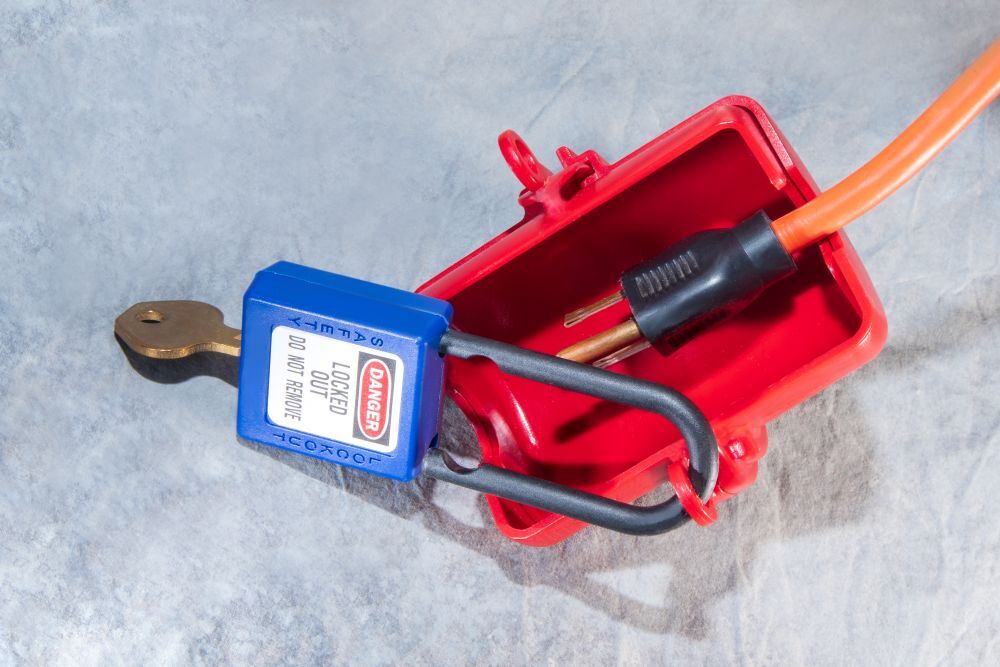

No matter the level of industry hazard, all general industry businesses must implement elements of Lockout Tagout if they apply to their business according to the OSHA Standards.
A covered employer should develop a Lockout/Tagout Program to protect workers from hazardous energy when repairing or performing preventive maintenance on equipment. Learn more at ESFI - Electrical Safety Foundation International.
Lockout / Tagout (LO/TO) Program
The purpose of LO/TO is to de-energize the equipment, therefore, the employer must assess hazardous energy sources and develop procedures to control the hazardous energy. The employer must recognize that during servicing and/or maintenance of equipment, employees have the potential to be involved in a serious or fatal accident caused by the unexpected start-up of equipment or the release of stored energy.
A Lockout / Tagout program should be developed to establish procedures for the control of hazardous energy. This policy should be intended to comply with the requirements of OSHA standard 29 CFR 1910.147, Control of Hazardous Energy (lockout/tagout), and the provisions of OSHA's Electrical Safety-Related Work Practices Standards: 29 CFR 1910.331; 1910.332; 1910.333; 1910.334; and 1910.335.
The written Lockout/Tagout policy should include:
º Purpose – identifies the need for the program and important definitions.
º Applicability – distinguishes when an operation is regulated by the lockout/tagout policy.
º Training – recognizes the need for educating each employee or contractor involved in or affected by lockout before being allowed to work in the area with equipment or systems that are subject to lockout/tagout.
º Lockout/Tagout procedures – details the formal methods, procedures, and equipment to be used to ensure that before any employee or contractor performs any servicing or maintenance on a machine or equipment where unexpected energizing, start up or release of stored energy could occur and cause injury, the machine or equipment shall be isolated, and rendered inoperative.
º Steps for Restoration of equipment and removal of Locks and Tags – delineates important procedures that must be followed whenever any locked or tagged out equipment will be brought back into service or whenever locks or tags are to be removed.
º Annual Review – ensures that procedures are adequate and are being followed.
º Outside Contractor – evidences their lockout/tagout program training.
º Lockout/Tagout Equipment List - pinpoints equipment requiring implementation of lockout/tagout devices prior to maintenance or repair work being performed and procedures for each piece of equipment.
º Annual Lockout/Tagout Program Audit Report - indicates authorized and affected employees who have been trained on the lockout/tagout procedures.
º Lockout Tagout Record– includes signature, date and time of affected employees regarding notification, shutdown, disconnection of power sources, lockout, safety check.
º Restoring Equipment to Service Record – includes signature, date, and time of authorized employees regarding job completion/certification, equipment/personnel check, and startup.
According to OSHA’s 1910.147 requirement, if you have any employees who perform repairs or preventive maintenance on equipment in your business, then you must develop, document and utilize the control of potentially hazardous energy otherwise known as lockout/tagout. Contact SafeLink if you need assistance in meeting OSHA’s requirements for determining which equipment requires lockout, setting up your Lockout/Tagout program and how to develop written procedures.
Learn more OSHA’s electrical safety requirements.
Read our blog on Elements of an Effective Electrical Safety Policy.
Learn about dental compliance.